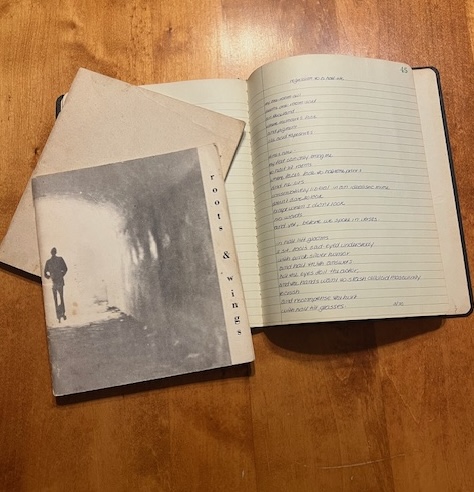
Long ago, I used to be a poet. Or, if I want to be really fancy, a poetess, with all the mystique that goes with it. That began in college when I was hooked on reading the works of poets like William Butler Yeats, Ezra Pound, and T.S. Eliot. I hung around other poet-types.
I was fortunate to have an outlet for my poetry through Bridgewater State’s literary publications, Roots and Wings, and later Conceit. (I still have copies.) Here’s how one called Regression to a Half-Life begins:
my one-room cell
seems one-room sold
an Alice land
where memories pigment
and fuse like acid tapestries
Okay, I will spare you the others, some of which I will admit are cringe-worthy. However, I still like my sarcastic review of Rod McKuen’s poetry — in poetic form for the college’s newspaper. That’s when I used the pseudonym Ethel Schwartz — yes, there’s a story there. Here’s the start.
At times I feel
There’ll be no flag days any more
And, then, you come, Rod McKuen
Waving yours.
I kept writing poetry, many of them carefully hand-written in a hard-cover notebook, which also contains earlier poems, including one in French I wrote in high school, called Le Mirage. It begins: “Je l’ai vu passer á sa table usuelle.” My best guess is that my heart was broken by a boy. I also wrote a few when I worked in a psychiatric half-way house, the inspiration for my novel, The Swanson Shuffle.
But then I stopped creating poetry, actually writing at all. My attention was drawn elsewhere, my family, actually. I really wanted to write novels but, alas, that didn’t happen until many years later. And then I couldn’t stop myself. Now, I have 17 books published and three more waiting in the wings. The next book is The Unforgiving Town. You will be hearing a lot more about that one soon.
So, what did I learn from writing poetry? To be concise is one thing. To show not tell is another. I so enjoy creating pictures that people can visualize when they read the words I put together.
For instance, this is how I described a dead man found on a roadside in The Unforgiving Town: Blood covered much of his face and the pavement beneath his head. His body and legs were twisted in an unnatural way, his arms spread wide as if he had given up.
Do I write poetry anymore? Well, sort of. The victim and a chief suspect inChecking the Traps, the third book in my Isabel Long Mystery Series, wrote poetry, so that meant I had to do be a poet again. Here’s a line I channeled for the victim: The wind tells me things my mother never did.
Hmm, not bad.