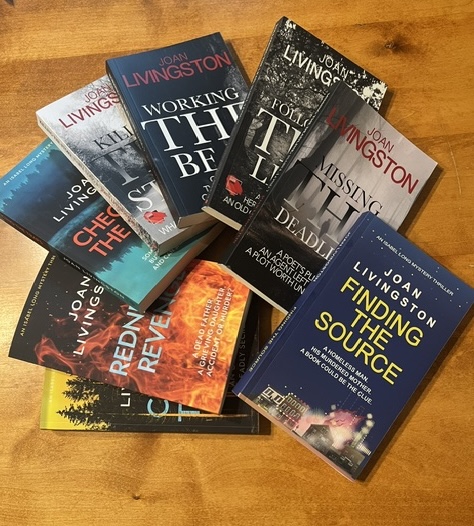
For the past several months, I have been so immersed in writing screenplays, editing, and other projects that I had to set aside the next book in my Isabel Long Series — Covering a Crime. She and I were nearly halfway there. But it’s time to give Isabel the attention she deserves. Afterall, she has another murder to solve. Readers have been asking.
Days ago, I reread the manuscript, making edits as I went along, admittedly happy with what I’d written so far. Then it was time to move forward, and as has been my practice, I work on the book first thing in the morning after I’ve poured myself a cup of coffee and make a pot of oatmeal. As mentioned before, my aim is around 500 words a day, a number that makes writing enjoyable. I also find myself thinking about what to write next when I am doing chores that don’t require my total attention.As of this morning, I have written an additional 2,000 words. I figure I have a few months to go to reach the end.
No, I haven’t stopped other writing projects, but at this point they need to move over a bit, so I can give this book the space it needs and deserves.
This is Isabel’s ninth mystery to solve. She only takes on cold cases and leaves the rest to law enforcement. And she strictly does her sleuthing in the fictional hilltowns of Western Massachusetts although an unsolved case from her hometown looms. Isabel was young girl when her cousin went missing and her body was found buried in a wooded area many years later. Isabel feels she is sharpening her skills so she can take this one on.
Many of Isabel’s cases involve deaths that were ruled accidental although a person close to the victim feels otherwise. Or they simply went missing such as the baby who was kidnapped from a family’s front yard. In one case, a literary agent survived getting shot in the head but isn’t the same.
The victims are an interesting assortment. Isabel and I like it that way. Among them have been a junkyard dealer, a highway worker who wrote poetry, a newspaper editor, and a book store owner. The culprits? Them, too, and to be honest I don’t know whodunnit until the end when Isabel figures it out. And that’s true about Covering a Crime.
When I started thinking about book nine, the one detail I wanted to include was the card game of cribbage. I don’t play cribbage, but my husband and a number of friends do on a regular basis, actually twice a week, at our son’s Floodwater Brewing in our village. I just stop by to trash talk.
As in all but her first case, Isabel is approached by someone who knew the victim. In this one, it is Sean Mooney, who was an intern when she used to be editor-in-chief of a newspaper. Sean asks Isabel to investigate the death of his grandfather, Zeb Taylor, a famous artist who had moved to the hilltowns. Zeb disappeared while his wife was away for a few days. It appeared to be a case of an older man with dementia getting lost in the deep woods behind his home. A search was conducted but nothing turned up until three years later when Zeb’s remains, just bones, hair, and clothing, were found — in a neighboring town.
Zeb liked the change when he left New York City for the sticks. He got to know the locals, even painting a few, typically naked, and hung out at the local country bar playing cribbage. Zeb was allegedly a cheater. He also had a bit of a wandering eye and had one known enemy. His widow, Gladys, still lives in their home with her new husband. Zeb’s studio in a converted barn remains intact.
Many of the characters who appeared in the other books are in this one, such as Isabel’s mother, Jack Smith (he teaches Isabel how to play cribbage), the Old Farts who gossip in the backroom of the store, Annette Waters, basically anyone I loved too much to let go just yet. It feels good to be back with them all.